تحليل شعاع شعاع ضوء ملعب كرة القدم الشمسي
المقدمة في الإضاءة المهنية لملعب كرة القدم 11v11، “السطوع” هو فقط نصف القصة.إن التحدي الحقيقي يكمن في الدقة.بدون زوايا الشعاع الأيمن، أ
Home > insights
Technical Engineering Guides for Solar LED Optics & Battery Systems

Step-by-Step Installation & Maintenance for Solar Lighting Masts
The Ultimate Buyer’s Guide for Solar Sports Lighting & ROI Analysis
Global Solar Football Stadium Case Studies & Success Stories
Industry Trends & Future Innovations in Renewable Sports Lighting
Frequently Asked Questions About Solar Football Pitch Lighting
Tailored Solar Lighting Solutions for Professional & Community Fields

المقدمة في الإضاءة المهنية لملعب كرة القدم 11v11، “السطوع” هو فقط نصف القصة.إن التحدي الحقيقي يكمن في الدقة.بدون زوايا الشعاع الأيمن، أ

Planning the lighting for a standard 11v11 football field is a significant undertaking. Unlike small recreational courts, a full-sized stadium requires precision engineering to ensure

Introduction The football stadium industry is evolving rapidly, driven by technological innovations, sustainability goals, and community demands. From artificial turf advancements to hybrid solar lighting

General Questions Q1: What types of football fields are available?A1: Football fields can range from small 7v7 community pitches, 9v9 university fields, to full-sized 11v11
Introduction Football stadium projects vary widely in scale, design, and application. Examining case studies helps clubs, schools, and communities understand practical solutions, challenges, and outcomes.
Introduction Selecting the right equipment and infrastructure for a football stadium is crucial for ensuring performance, durability, and cost-effectiveness. From small community pitches to professional
Introduction Proper installation and maintenance are crucial for the performance, safety, and longevity of football stadiums. Whether for community fields, school playgrounds, or professional 11v11
Introduction Understanding technical aspects is crucial for designing, building, and maintaining high-performance football stadiums. From pitch dimensions and surface types to lighting and energy systems,
Introduction Building a football stadium does not always require a large budget. Low budget stadiums are ideal for schools, local clubs, and community organizations looking
Introduction Hybrid solar + grid systems combine the benefits of renewable solar energy with reliable grid power to ensure uninterrupted stadium lighting. This design is
Is commissioning required after installation?
Yes. System commissioning is recommended after installation to verify electrical connections, controller settings, and lighting performance, ensuring the system operates as designed.
Can the system be installed in remote or off-grid locations?
Yes. The system is specifically designed for remote and off-grid locations, where access to utility power is limited or unavailable.
How are lighting poles and foundations installed?
Lighting poles are installed on concrete foundations designed according to pole height, wind load, and soil conditions. Foundation drawings are provided to ensure structural stability and long-term safety.
Does the system require trenching or underground cabling?
Minimal trenching is required. As the system operates independently of the grid, underground cabling is significantly reduced compared to traditional lighting systems, simplifying construction work.
Are installation drawings and technical documents provided?
Yes. Detailed installation drawings, wiring diagrams, foundation layouts, and technical documentation are provided to support proper and safe installation.
Are professional installation teams required?
Basic electrical and mechanical experience is recommended. The system can be installed by local contractors following provided drawings and guidelines. On-site or remote technical support can be provided if required.
How long does it take to install a solar football stadium lighting system?
Installation time depends on field size and system configuration. For a typical football training field, installation can usually be completed within several days after foundations are ready.
Is the installation process complicated?
The installation process is straightforward and modular. The system is designed for easy on-site assembly, with pre-configured components that reduce installation time and construction complexity.
Are solar football lighting systems suitable for developing markets?
Yes. Solar football stadium lighting systems are well suited for developing markets due to their reduced infrastructure requirements, scalability, and long-term cost advantages.
Is the system suitable for temporary or modular installations?
The system can be configured for semi-permanent or modular installations, depending on project requirements. This makes it suitable for temporary sports events or phased development projects.
Can the system support multi-purpose sports fields?
Yes. The lighting system can be designed to support multi-purpose sports fields by adjusting lighting layouts and control strategies to meet the requirements of different sports activities.
Is the system suitable for school and community projects?
Yes. Solar football stadium lighting systems are widely used in schools and community projects due to their low operating costs, safety, and independence from grid electricity.
Can the system be used in different climate conditions?
Yes. The system can be designed for various climate conditions, including hot, cold, humid, and coastal environments, with component selection and protection levels adjusted accordingly.
Is the system suitable for remote or off-grid locations?
Yes. The system is specifically designed for off-grid and remote locations where utility power is unavailable or unreliable, making it ideal for rural areas and infrastructure-limited regions.
Can the system be used for both training and match lighting?
The system is primarily designed for training and recreational football fields. For match-level lighting requirements, system configurations can be evaluated and customized based on project-specific standards and conditions.
What types of football fields is the system suitable for?
The system is suitable for training fields, community and school football fields, semi-professional pitches, and recreational football facilities. System configurations can be adjusted to match different field sizes and lighting requirements.
How does the system perform over long-term operation?
With proper system design, quality components, and routine maintenance, the system is capable of maintaining stable lighting performance and energy efficiency over long-term operation.
Can the system be monitored remotely?
Yes. With optional smart IoT monitoring modules, system performance, battery status, and operating data can be monitored remotely, enabling proactive maintenance and fault diagnosis.
How does the system handle component failures?
The system is designed with modular components, allowing individual parts such as lights, batteries, or controllers to be replaced without affecting the entire system.
What maintenance is required for solar panels?
Solar panels generally require minimal maintenance. Occasional cleaning to remove dust or debris helps maintain optimal energy generation, especially in dusty or high-pollution environments.
Does the system require frequent maintenance?
Routine maintenance is minimal. Periodic inspections of lighting fixtures, mounting structures, and electrical connections are recommended to ensure optimal performance and system safety.
How long do the batteries last, and when do they need replacement?
Lithium batteries generally have a service life of several years, depending on battery type, depth of discharge, operating temperature, and charge-discharge cycles. Replacement schedules are determined based on actual operating conditions.
What is the expected lifespan of the LED floodlights?
High-quality LED floodlights typically have a service life of 50,000 hours or more, depending on operating conditions, thermal management, and usage patterns.
How reliable is a solar football stadium lighting system?
The system is designed for long-term outdoor operation using industrial-grade components and proven system architecture. Properly designed systems can provide stable and reliable lighting performance throughout their service life.
Do you provide on-site or remote support during installation?
Yes. We provide technical guidance either on-site or remotely to ensure proper installation, commissioning, and system optimization.
How flexible is the system design for unique project requirements?
The system design is highly flexible. Components, layouts, and control strategies can be adjusted to meet unique project constraints such as terrain, climate, or energy availability.
Can the system be adapted for phased or temporary installations?
Yes. The system can be configured for modular or phased installations to accommodate temporary events or projects developed in stages.
Do you offer assistance during project planning?
Yes. Our engineering team can provide technical consultation, feasibility studies, and project planning support to help clients make informed decisions.
Can you integrate smart monitoring and IoT features?
Yes. Optional IoT modules allow remote monitoring of system performance, energy consumption, and fault alerts, enabling proactive management.
Are international standards and local regulations supported?
Yes. Systems can be designed to comply with international sports lighting standards (FIFA, EN 12193) and local regulations based on project requirements.
Can you provide design simulations before project implementation?
Yes. We provide lighting simulations, layouts, and calculations to verify illuminance levels, uniformity, and system performance before installation.
Can the system be customized for different field sizes?
Yes. The lighting system can be tailored to match the dimensions of the football field, required illuminance, and usage hours to ensure optimal performance for each project.
How are warranty claims handled?
Warranty claims are handled promptly. Customers submit a claim with details and photos of the issue, and our team coordinates replacement parts, repairs, or remote guidance according to warranty terms.
Can training be provided for local maintenance teams?
Yes. We offer training sessions for local operators and maintenance personnel, covering system operation, routine maintenance, and troubleshooting procedures.
Can training be provided for local maintenance teams?
Yes. We offer training sessions for local operators and maintenance personnel, covering system operation, routine maintenance, and troubleshooting procedures.
Can training be provided for local maintenance teams?
Yes. We offer training sessions for local operators and maintenance personnel, covering system operation, routine maintenance, and troubleshooting procedures.
Is technical support available during operation?
Yes. Our engineering team provides ongoing support to monitor system performance, advise on maintenance, and assist with troubleshooting whenever needed.
Are replacement parts available?
Yes. Replacement parts such as LED lights, batteries, controllers, and cables are readily available to ensure quick repairs and minimal downtime.
How is after-sales support provided?
After-sales support includes remote technical assistance, troubleshooting guidance, replacement of defective components, and periodic maintenance advice to ensure long-term system performance.
What warranty is provided for the system?
Standard warranty covers LED floodlights, batteries, controllers, and other major components. Warranty periods vary by component, typically ranging from 2–5 years, depending on product type and agreement terms.
How is the system packaged for transportation?
All components are carefully packaged to prevent damage during transit. Solar panels, LED floodlights, batteries, and controllers are packed in sturdy boxes or pallets, and sensitive components are protected with foam and cushioning materials.
What is the typical delivery time for a solar football stadium lighting system?
Delivery time depends on system configuration, project size, and production schedule. For standard systems, delivery usually takes 4–8 weeks after order confirmation.
Are discounts available for bulk orders?
Yes. Discounts or preferential pricing may be available for bulk orders or long-term project partnerships, subject to negotiation.
How can we start a project with your company?
To start a project, provide basic project information, discuss requirements with our team, and confirm system design and quotation. Once the agreement is signed and deposit is paid, production and delivery will commence.
Can you support large-scale or multi-field projects?
Yes. Our team can design and supply multiple systems simultaneously for large-scale projects, coordinating production, logistics, and installation schedules.
What payment terms are available?
Payment terms are negotiated based on project scope and agreement. Typically, payments are split between an initial deposit, progress payments, and final settlement upon delivery.
How can I request a quotation?
Clients can request a quotation by providing project details, including field size, desired lighting level, location, and any special requirements. Our team will respond with a detailed proposal and cost estimate.
What is the minimum order quantity (MOQ)?
Typically, systems are designed for individual football fields. The minimum order is usually one complete system, but larger projects or multiple fields can be accommodated.
Is there a standard price list available?
Due to the customized nature of each system, a standard price list is not provided. Pricing is based on project-specific design, technical requirements, and optional features.
How is pricing determined for a solar football stadium lighting system?
Pricing depends on system configuration, field size, component selection, and optional features such as IoT modules or custom layouts. Each project is quoted individually based on client requirements.
What are the key advantages of a solar football stadium lighting system?
Key advantages include independence from the power grid, reduced operating costs, simplified installation, environmental sustainability, and reliable lighting performance in remote or infrastructure-limited locations.
How does a solar lighting system ensure reliable night-time operation?
The system uses properly sized solar panels and battery storage combined with intelligent energy management through MPPT controllers. This design ensures sufficient energy is stored during the day to support stable lighting operation throughout the night, even under variable weather conditions.
Can the system be customized for different project requirements?
Yes. Each system is designed based on specific project conditions such as field dimensions, required illuminance levels, local solar resources, climate conditions, and operating hours. Customization ensures optimal performance and long-term reliability.
What types of football fields is the system suitable for?
The system is suitable for a wide range of football fields, including training grounds, community and school fields, semi-professional pitches, and remote or off-grid football facilities. System configurations can be adjusted based on field size, lighting level requirements, and usage frequency.
What are the main components included in the system?
A standard solar football stadium lighting system typically includes:
Does the system require grid power or external electricity?
No. The system is fully off-grid and operates entirely on solar energy. All electricity required for night-time lighting is generated during the day and stored in batteries, making it ideal for locations without access to reliable grid power.
Is this a complete lighting system or just solar floodlights?
This is a complete, integrated lighting system, not individual products. The solution includes lighting design, energy generation, battery storage, control systems, mounting structures, and system configuration to ensure stable and reliable performance for football field applications.
What is a solar football stadium lighting system?
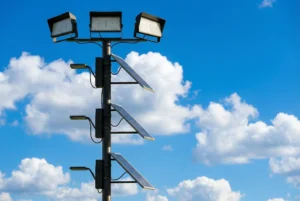
A solar football stadium lighting system is a complete off-grid lighting solution designed specifically for football fields. It integrates high-efficiency LED floodlights, solar panels, lithium battery storage, smart lighting controllers, and lighting poles into a unified system that operates independently from the utility grid.
How is the lighting system designed for a specific football field?
Each system is designed based on the football field dimensions, required illuminance levels, pole height and layout, operating hours, and local solar irradiation data. Professional lighting calculations are used to ensure uniform illumination and compliance with relevant sports lighting standards.
What lighting standards can the system meet?
The system can be designed to meet common football lighting requirements for training and recreational fields. Depending on project requirements, designs may reference FIFA training field guidelines, EN 12193, or equivalent regional sports lighting standards.
How many lights and poles are required for a football field?
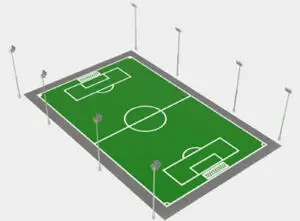
The number of lights and poles depends on the field size, target lux levels, pole height, and optical distribution of the LED floodlights. Typical configurations range from 4 to 8 poles for standard training fields, with detailed layouts determined through lighting simulations.
How is the solar panel and battery capacity calculated?
Solar panel and battery capacity are calculated based on daily energy consumption, required operating hours, local peak sun hours, and system efficiency. Battery capacity is designed to support multiple nights of operation, including periods of reduced solar input.
How many days of backup can the system provide during cloudy or rainy weather?
Backup duration depends on the system configuration and project location. Most systems are designed to provide reliable lighting for several consecutive cloudy or rainy days through properly sized lithium battery storage.
What type of lighting control system is used?
The system uses intelligent solar lighting controllers with MPPT technology to optimize energy harvesting and battery charging. Controllers support programmable schedules, dimming strategies, and optional remote monitoring via IoT modules.
What pole height and structural design are recommended?
Pole height is determined by field size, lighting uniformity requirements, and glare control. Structural design considers wind load, corrosion resistance, and installation conditions, with poles typically hot-dip galvanized for long-term durability.
Can lighting performance be simulated before installation?
Yes. Lighting simulations and system calculations can be provided during the design stage to verify illuminance levels, uniformity, and overall system performance before project implementation.